

Plastic is just plastic, right? Well, nothing could be further from the truth. Plastic is available in many different versions. Plastic is synthetic.
Plastic in the Dutch language is a plastic from which an object can be made by plastic shaping (heating in a mold under pressure). This is then referred to as a thermoplastic.
Plastics are all chemical compounds made by non-natural chemical processes. Plastic is an organic material that is made up of very large molecules that arise through the synthesis (a reaction that creates a new substance) of the raw materials. Plastics are the most versatile materials in our modern world and ideally suited for injection molding.
Why is plastic so widely used? Some advantages at a glance are that it is maintenance-free, lightweight, easily recyclable, bacteria-resistant, no adhesion of other (polluting) substances, no rust, it has a good resistance to chemicals, easy to shape, easy to integrate functions, durable and robust, available in transparent version, it is thermal and acoustically insulating, and available in biodegradable types.
Plastics are produced with raw materials that occur in nature such as natural gas, oil, coal, minerals, and plants. The first synthetic plastics were derived from cellulose, a substance found in plants and trees. Cellulose was heated with chemicals and resulted in a new material that was extremely durable. The raw materials for today’s plastics come from many places, but most plastics can be made from the hydrocarbons readily available in natural gas, oil, and coal. It is increasingly common for plastics to be made from renewable raw materials such as wheat, corn, soybean oil, sugar cane, potatoes, bananas or cassava. These raw materials can in turn be combined with reinforcing raw materials such as wood fiber, hemp fiber or elephant grass.

What are plastics? The chemistry of plastics can be complex, but the basics are simple. Think back to high school physics classes about atoms and molecules (groups of atoms). Plastics are simply chains of equivalent molecules linked together. These chains are called polymers. Poly means a lot. A very long polymer chain is also called a macromolecule (macro means very large). That is why many plastics start with ‘poly’, like polyethylene, polystyrene, and polypropylene. Polymers are often made of carbon and hydrogen and sometimes of oxygen, nitrogen, sulfur, chlorine, fluorine, phosphorus or silicon. The term “plastics” includes all of these different polymers. Although there are many polymers, plastics are generally lightweight with a significant degree of strength. Plastics can be sprayed, extruded, molded, and blown into seemingly limitless shapes.
Types of plastics
The way in which the macromolecules are connected to each other determines the type of plastic that is created. There are three main groups, which all have different properties:
1 Thermoplastics (or plastics): The thermoplastics are subdivided into amorphous and crystalline thermoplastics
2 Thermosets
3 Elastomers (rubbers)
Thermoplastics
In thermoplastics, the macromolecules are separated from each other. They are also crisscrossed together. The macromolecules are connected to each other by intermolecular bonds (loosely tight). When heated, a thermoplastic first becomes plastic and then becomes a thick liquid. The English name for thermoplastics is plastics. This name means that they are plastically deformable.
- Thermoplastics can be remelted and processed
- New products can be made from the grinding of old products and waste.
- No mixing with other plastics may take place during reprocessing and there are two types of thermoplastics: amorphous and crystalline.
Amorphous Thermoplastics
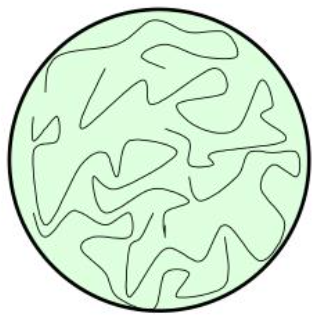
In amorphous thermoplastics, the long macromolecules are crisscrossed together. The macromolecules form a single large tangle. This tangle is comparable to all loose pieces of rope, mixed together. An important characteristic of amorphous thermoplastics is that they are translucent. They can be crystal clear. Some examples are PS, PMMA, PC and ABS.
Crystalline thermoplastics
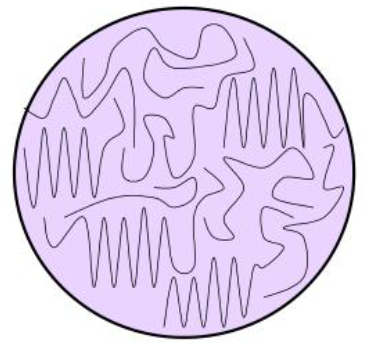
The macromolecules are more ordered in crystalline thermoplastics. There are many small areas with an amorphous structure. In between are areas where the macromolecules sit neatly against each other. The macromolecules are arranged in these areas, just like spoons in a box. This is the crystal structure.
When the material is melted, the molecules are disordered, just like in an amorphous thermoplastic. During cooling, the macromolecules sit in an orderly fashion, which is called crystallization. Crystallization takes some time. If the macromolecules sit neatly against each other, they take up less space. The shrinkage of a crystalline thermoplastic therefore consists of shrinkage by cooling plus shrinkage by crystallization, so the shrinkage of these crystalline thermoplastics is great. Some examples are PA, PE, PP and POM.
Thermosets
Thermosets are interwoven into a kind of network. They are interconnected to form one large macromolecule. This is comparable to one large three-dimensional fishing net. The molecules in the hot mold only form a chemical bond when a thermoset is processed. After cooling, the molecules are firmly bonded to each other. If we heat a product from a thermoset, it remains hard and retains its shape. They cannot be melted and reprocessed. Some examples are PF, PUR, MF and UF.
Elastomers
In elastomers, macromolecules are bonded together in a few places. The macromolecules can move relatively to each other under a load. They still remain connected. So they can stretch and spring back, just like a rubber band. Thermoplastic elastomers (also called TPEs) can be remelted and processed. Commonly used elastomers are SBR and TPO.
Plastic injection molded products are mainly made from thermoplastics. Injection molding of thermosets or elastomers often requires special adaptations.